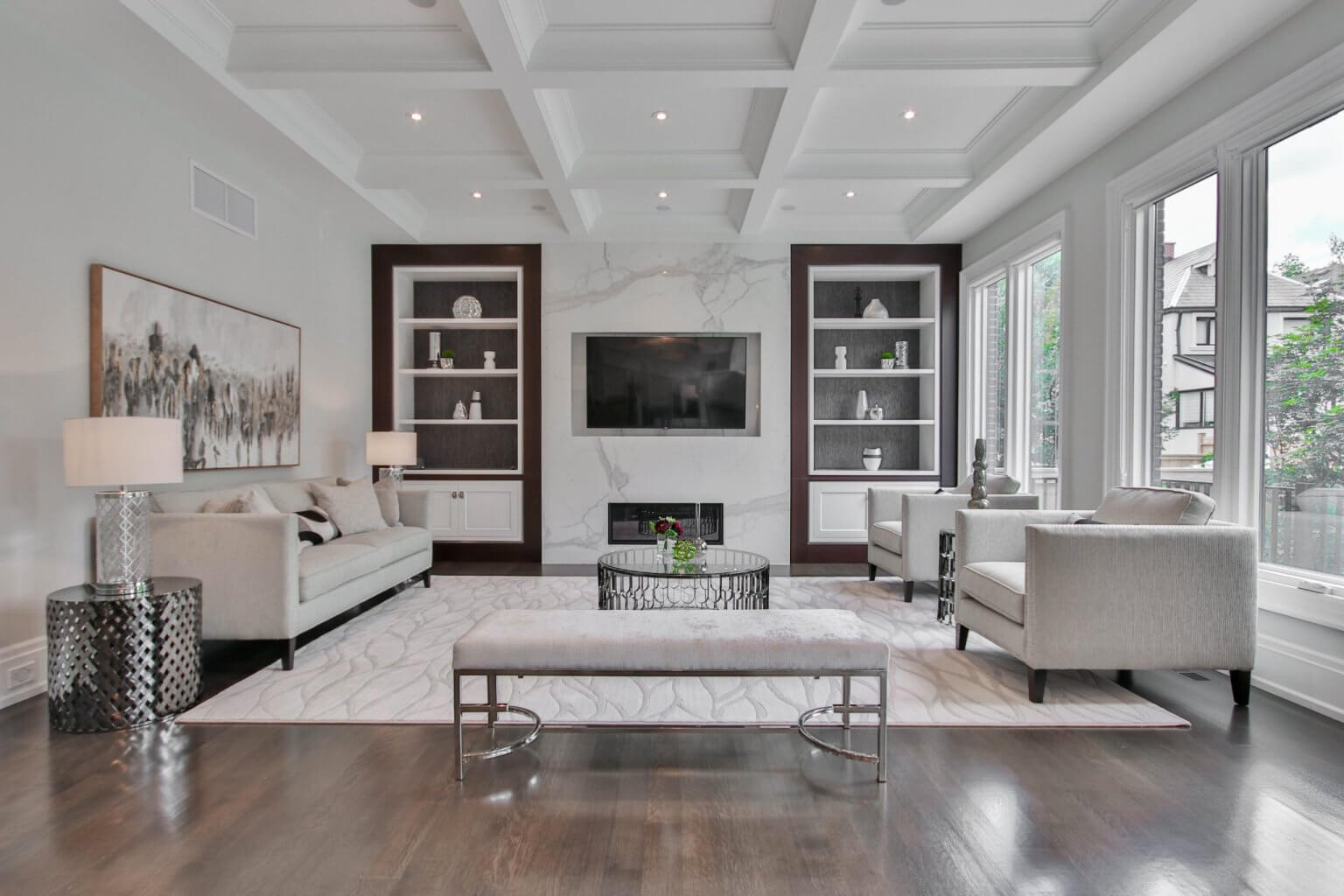
White is tricky. Most people think painting a room white is the "safe" choice, a blank slate that anyone can handle without a degree in interior design. Then they finish the second coat, step back, and realize their home looks exactly like a local dental clinic. It’s sterile. It’s flat. It’s honestly a little depressing when the 4:00 PM winter light hits it.
Designing a white color living room isn't about the absence of color; it’s about the presence of texture and light. If you get it wrong, you’re living in a lightbox. If you get it right, you have a sanctuary that feels expensive and airy.
The Secret Physics of White Paint
You’ve probably stood in the paint aisle at Home Depot or Benjamin Moore staring at two hundred swatches of "white." It’s overwhelming. But here is the reality: white paint is a mirror. It has no personality of its own; it only reflects what is happening outside your window and what is sitting on your floor.
If you have a north-facing room, the light coming in is naturally bluish and cool. If you slap a "pure white" or a "cool white" on those walls, the room will look grey and gloomy. Designers like Kelly Wearstler or Shea McGee don't just pick a white; they analyze the "Light Reflectance Value" (LRV). An LRV of 100 is pure white; 0 is black. Most successful white living rooms sit in the 80 to 90 range.
For rooms that feel "dead," you usually need a white with a yellow or pink undertone—think White Dove by Benjamin Moore. It sounds counterintuitive to put yellow in your white, but that’s what creates the "glow" you see in architectural magazines. Conversely, if you have massive south-facing windows with intense sun, a warm white might turn straight-up butter yellow by noon. In that specific case, you’d want something like Chantilly Lace, which is crisp and cuts through the heat of the sun.
Why Texture Is Non-Negotiable
A white color living room fails when every surface has the same "hand." If you have white drywall, a white leather sofa, and a white laminate coffee table, the human eye has nowhere to rest. Everything blurs into a single, flat plane. This is where "visual weight" comes in.
You need grit.
Think about a chunky wool throw. A jute rug that feels slightly rough underfoot. A linen sofa with visible slubs in the fabric. A reclaimed wood mantle. When you strip away the distraction of color, the shape and feel of objects become the main characters.
I’ve seen dozens of homes where the owner complained the room felt "unfinished." Usually, the fix wasn't more furniture; it was just swapping a cotton pillow for a velvet one. It creates shadows. Shadows are the only reason white rooms look good. Without shadows, you just have a hospital wing.
The "Museum" Misconception
We need to talk about the "all-white" lie. Very few iconic white living rooms are actually 100% white. They are usually 80% white, 15% wood tones, and 5% black or brass.
Look at the work of Leanne Ford. She is the queen of the white-on-white aesthetic. But if you look closely at her projects, there is almost always a dark element—a black metal window frame, a charred wood stool, or even just a very dark book on a coffee table. This is "grounding." Without a dark anchor, a white room feels like it’s floating away. It’s unmoored. You need that tiny bit of high contrast to make the white actually look whiter by comparison.
Durability and the "Kids and Dogs" Factor
"I can’t do a white living room, I have a life."
I hear this constantly. And honestly, ten years ago, I would have agreed. If you spilled red wine on a white sofa in 2012, that sofa was headed for the landfill. But the technology has changed. Performance fabrics like Crypton or Sunbrella (which used to be just for patio furniture but is now soft enough for the indoors) have made white living rooms functional for actual humans.
Bleachable slipcovers are another "pro" secret. Brands like Sixpenny or IKEA’s higher-end linen lines allow you to literally throw the entire exterior of your sofa into a washing machine with a cup of bleach. It’s arguably cleaner than a navy blue sofa that hides five years of dust and skin cells.
The Lighting Trap
If you use 5000K "daylight" LED bulbs in a white color living room, you are making a massive mistake. It will look like a gas station.
White walls need warm light to feel inviting. Stick to 2700K or 3000K bulbs. When the sun goes down, you want the walls to take on a honeyed, candlelit quality. Overhead lighting is also the enemy here. Rely on "layering"—a floor lamp in the corner, a task light by the chair, and maybe some picture lights over art. This creates pockets of light and dark, which, again, gives the room the depth it’s missing when everything is just... white.
Art and the Negative Space
People often panic and try to cover every white wall with art because they fear the "emptiness." Don't.
The beauty of a white palette is the appreciation of negative space. One large, impactful piece of art—even something monochromatic or a simple black-and-white photograph—usually looks better than a cluttered gallery wall. Let the wall breathe. The white space acts as a frame for your life.
Actionable Steps for Your Space
If you are staring at a boring room right now and want to transform it into a high-end white sanctuary, start here:
- Check your orientation. Figure out if your windows face North, South, East, or West. Buy three sample pots of white paint with different undertones (one warm, one cool, one neutral) and paint large 2-foot squares on different walls. Watch them for 24 hours.
- Layer three different textures. Go to your living room. If everything is "smooth," go buy one thing that is "rough" (seagrass basket), one thing that is "soft" (mohair throw), and one thing that is "matte" (ceramic vase).
- Audit your "anchors." Find one item in the room that is dark—black, deep charcoal, or dark walnut wood. If you don't have one, get one. It can be as small as a black picture frame or a dark tray on the ottoman.
- Swap your bulbs. Check the base of your lightbulbs. If they say 5000K, replace them with 2700K "Warm White" immediately. The difference is instant.
- Look at the floor. If you have white walls and light floors, you need a rug with some visual weight to stop the furniture from "sliding" visually across the room. A vintage Persian rug with muted, faded colors works wonders in an otherwise white space.
A white living room isn't a lack of effort. It’s a deliberate choice to let light and texture do the talking instead of loud colors. It requires discipline, but the payoff is a home that feels like a deep breath every time you walk through the front door.