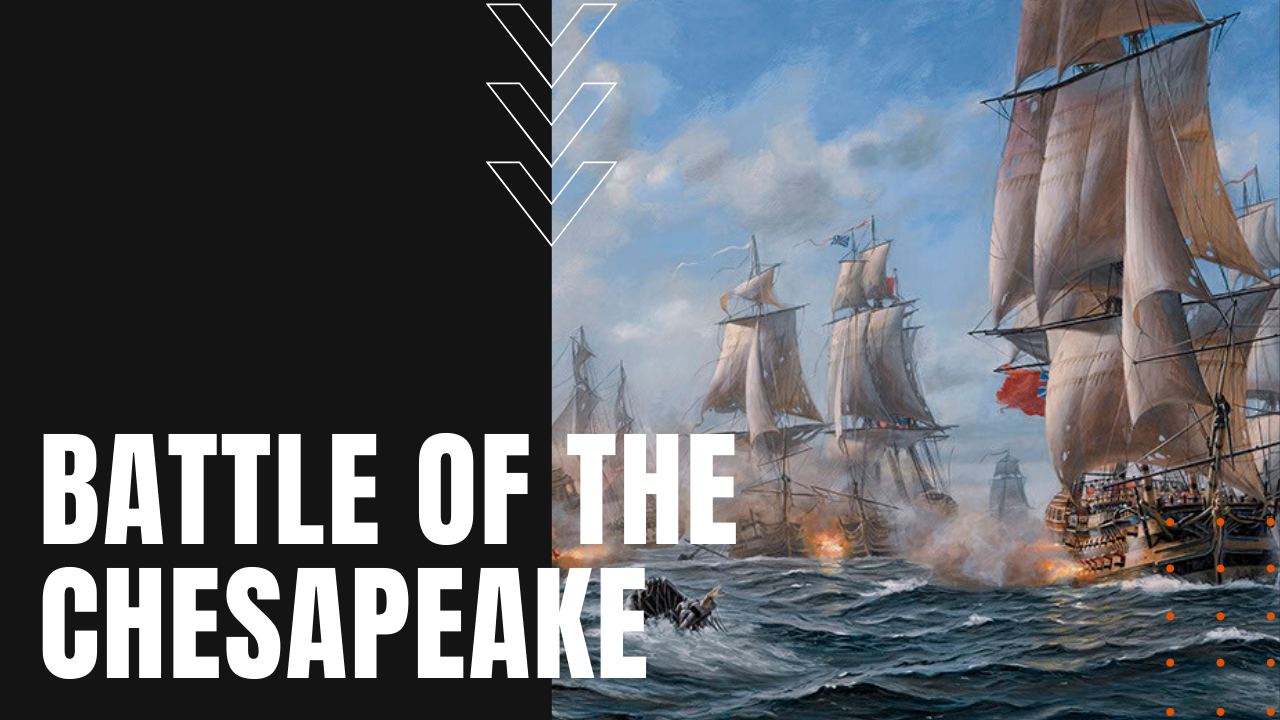
History books usually paint the American Revolution as a gritty series of land battles—think frozen feet at Valley Forge or the desperate crossing of the Delaware. But honestly, the United States exists because of a naval fight where not a single American ship was present. It’s wild when you think about it. The Battle of the Chesapeake, fought in September 1781, is the most important naval engagement in Western history that most people can't actually describe.
Without this specific clash between the French and British fleets, Yorktown never happens. Cornwallis walks away. The war drags on for years, or maybe the rebellion just collapses under its own debt.
The Setup Nobody Remembers
By 1781, everyone was exhausted. The British were tired of chasing ghosts in the Carolinas, and George Washington was basically out of money and options. He wanted to hit New York City. He was obsessed with it, actually. But the French Admiral de Grasse had other ideas. He saw a massive tactical opening in the Chesapeake Bay.
Lord Cornwallis had parked his army at Yorktown. It seemed like a smart move at the time—a deep-water port where the British Royal Navy could easily resupply him or whisk him away if things got hairy. But he made a fatal assumption: he assumed the British would always control the waves.
The French fleet sailed up from the West Indies with 24 ships of the line. Meanwhile, Washington and Rochambeau began a frantic, dusty march south, praying that the French navy would actually show up and, more importantly, stay there.
What Actually Happened on September 5
When the British fleet under Thomas Graves arrived at the mouth of the Chesapeake, they expected to find a smaller French squadron. Instead, they saw the entire fleet of de Grasse anchored and ready.
The battle itself was a bit of a mess.
Eighteenth-century naval warfare relied on "the line of battle." Ships would line up in a long row and blast away at each other. But Graves’ signals were confusing. Some of his captains didn't know whether to follow the line or close in for the kill. This resulted in a disjointed attack where the British van (the front of the fleet) got absolutely hammered while the rear ships barely fired a shot.
The Battle of the Chesapeake wasn't a "sink 'em all" kind of victory. No ships were actually sunk during the heat of the fight. It was a tactical slog of shredded sails and splintered wood. The French had more guns and, crucially, their ships were in better repair. After a few hours of heavy cannonade, the fleets drifted apart.
Then came the weird part.
For the next several days, the two most powerful navies in the world just kind of floated near each other. They drifted south, watching, waiting, and repairing leaks. It was a maritime staring contest. Eventually, de Grasse slipped back into the Chesapeake Bay, where he found reinforcements waiting. Graves, looking at his battered ships and the now-overwhelming French force, decided he'd had enough. He sailed back to New York for repairs.
He left Cornwallis to die.
Why the British Blew It
It’s easy to blame Graves, and history usually does. He was a "by the book" officer who failed to adapt when the book wasn't working. But the failure goes deeper. The British were overstretched. They were fighting the French, the Spanish, and the Dutch globally. Their intelligence was bad. They didn't realize de Grasse had brought his entire fleet.
Also, the French had a technical edge. Many French ships were "copper-bottomed," meaning their hulls were sheathed in copper to prevent barnacles and wood-rotting worms. This made them faster and more maneuverable. In a game of inches, that mattered.
The Yorktown Connection
Once Graves sailed away, the trap snapped shut.
Washington’s troops arrived and began the siege. Cornwallis looked out at the water, expecting to see the Union Jack. Instead, he saw the white flags of Bourbon France. He was trapped between a massive land army and a naval blockade he couldn't break.
The Battle of the Chesapeake lasted only a few hours, but it dictated the terms of the surrender that ended the war. If the British had won that day, they would have evacuated Cornwallis, and Washington would have been left standing on a beach with no one to fight and no way to win.
Expert Nuance: Was it a French Victory or a British Loss?
Most naval historians, like the late David McCullough or the legendary Alfred Thayer Mahan, argue that this was a masterpiece of strategic positioning by de Grasse. However, a vocal minority of revisionists suggest it was more about British incompetence. Graves failed to use his "Attacking Orders" effectively, sticking to "Standing Orders" that were outdated.
There's also the weather factor. Winds were fickle. A slight shift in the breeze at 2:00 PM on September 5th could have changed the angle of the British approach and potentially broken the French line. History is often decided by a few degrees of wind.
Practical Takeaways for History Buffs
If you're visiting the area or studying the campaign, don't just look at the trenches in Yorktown. You have to understand the maritime geography.
- Visit Cape Henry: This is where the action actually started. There’s a memorial there today. Looking out at the mouth of the bay gives you a sense of just how narrow that bottleneck is.
- Study the Signals: If you want to understand why the British lost, look up the "Fighting Instructions" of the 18th century. The rigid signaling system was the "software" that crashed during the battle.
- Check the French Perspective: Most American accounts focus on Washington. To get the real story, read the logs of the Ville de Paris, de Grasse’s flagship. It was the largest and most powerful ship in the world at the time.
The Battle of the Chesapeake proves that sometimes the most important part of a revolution isn't the rebels themselves—it's the allies who show up at the exact right moment to block the exit.
Actionable Insights for Research
To truly grasp the impact of this engagement, you should look beyond general history textbooks which often gloss over the naval technicalities.
- Analyze the "Line of Battle" doctrine to understand why Graves couldn't simply "charge" the French. The tactical rigidity of the era is a fascinating study in organizational failure.
- Compare the casualty lists. The British suffered around 90 killed and 246 wounded, which seems small, but the damage to the masts was the real killer. A ship that can't sail is just a floating target.
- Investigate the role of the "Barfleur," the ship commanded by Samuel Hood. Hood was a brilliant tactician who spent the whole battle criticizing Graves in his head instead of helping him. The interpersonal drama between British admirals is a masterclass in how bad leadership loses wars.
Understanding the Battle of the Chesapeake requires acknowledging that the American Revolution was, in its final stages, a world war. The fate of the United States was decided by French sailors and British admirals who had likely never set foot in a colonial village. It remains the singular moment where the British Navy was out-thought and out-fought at the exact moment it mattered most.